Last updated 2026-08-21
TL;DR
A rigger selects, inspects, and connects slings and hardware so a crane can hoist a load. OSHA does not issue a rigger license. Employers must use a qualified person for assembly and disassembly hoisting and for certain work in the fall zone. Start on a crew or apprenticeship, document your training, then add NCCCO Level I if your sites ask for a card.
What is a rigger?
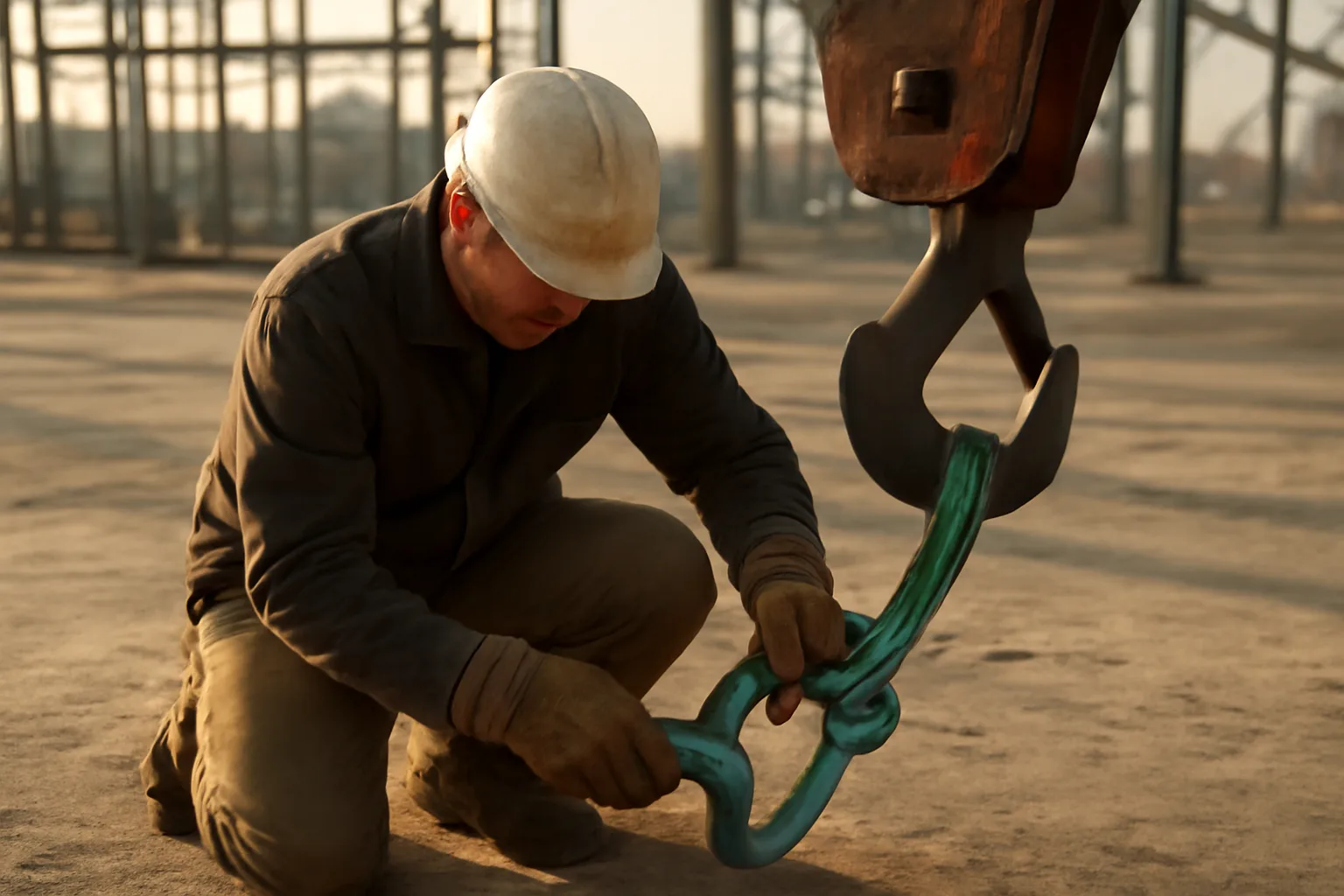
A rigger is the person who selects, inspects, and connects the hardware that holds a suspended load. You work slings, shackles, hooks, spreader bars, and hitches so a crane or hoist can move something without dropping it or tipping the machine.
That's the job. It is not the same as running the crane. Operators swing and boom. You build the connection between hook and load, and you read the geometry so the load does not shift, come unbound, or overload a leg.
OSHA's construction crane rule treats this as qualified-person work, not a hobby skill you pick up from a video. In 29 CFR 1926.1401, a qualified rigger "is a rigger who meets the criteria for a qualified person." [1] A qualified person, same section, is someone who by degree, certificate, professional standing, or "extensive knowledge, training and experience, successfully demonstrated the ability to solve/resolve problems relating to the subject matter, the work, or the project." [1]
People mix the word with theater rigging, marine cargo, and oilfield work. Those are real trades with their own customs. This guide covers the construction and industrial paper path, which is what most new people mean when they type how to start as a rigger.
You will hear signal person in the same breath. Signaling is a separate OSHA qualification under 29 CFR 1926.1428. [15] Some of you will hold both. Do not assume one card covers the other.
How do you start as a rigger?
You start by getting on a crew that actually hoists, then proving you can do the work under a supervisor. Nobody hands you the title. The cleanest legal start is hire-on as a helper or apprentice, documented training, and someone who will say you demonstrated the problems in 1926.1401. Certification helps you get past gate checks. It is not a federal license.
Here is the sequence I would follow if I were starting cold.
Get a job or a registered apprenticeship that touches steel, millwright work, pile driving, or plant maintenance. Ironworker apprenticeships teach rigging as a core block, not an elective. [9] Show up with boots, a tape, and the humility to fail a hitch in the yard before you fail it over someone's head.
Ask who on the site is the qualified rigger for assembly and disassembly. OSHA requires one during hoisting for assembly and disassembly. [2] Shadow that person. Write down sling types, angles, and how they reject hardware.
If your market wants a card, sit an accredited written and practical exam such as NCCCO Rigger Level I after you have handled gear for real. [6] Confirm current application steps and fees on the certifying body's own pages. Nobody should quote you a fee from a blog.
Keep a thin paper file: training records, inspection notes, and any lift plans you touched. Superintendents care about that file more than a patch on your hard hat.
Does OSHA require a rigger license?
No. Federal OSHA does not issue a rigger license and does not require a card from an accredited testing organization. A July 13, 2010 OSHA letter of interpretation says the Agency "does not require the qualified rigger to be qualified by an accredited testing organization or have other certification or designation." [11]
What OSHA does require is that the employer use a qualified rigger for certain hoisting work. Assembly and disassembly hoisting is one trigger. [2] Another is when people are in the fall zone hooking, unhooking, or guiding a load, or making the initial connection of a load to a component or structure. [3]
The national myth is that NCCCO is the license. It is a widely accepted way to document qualification, and nothing more. Employers still have to evaluate you for the actual lift. The OSHA fact sheet is blunt: "A certified operator does not necessarily meet the requirements of a qualified rigger." [4]
Some owners, refineries, and general contractors write certification into the site spec. That is a contract rule, not a statute. Follow the spec or you do not go through the gate.
States license crane operators more often than they license riggers. Confirm with the state licensing board or crane program if you work in a licensed-operator state. Do not assume a rigger card substitutes for an operator license, or the reverse.
| Situation | Qualified rigger required? | Where it lives |
|---|---|---|
| Assembly and disassembly hoisting | Yes | 29 CFR 1926.1404(r) |
| Workers in the fall zone hooking, unhooking, guiding, or making the initial connection | Yes | 29 CFR 1926.1425(c) |
| Operator also doing the rigging | Only if that operator meets the qualified rigger test | OSHA qualified rigger fact sheet |
| A federal rigger license from OSHA | No such license | OSHA interpretation, July 13, 2010 |
What is a qualified rigger under OSHA?
A qualified rigger is a rigger who meets OSHA's qualified person test for the rigging problems on that job. Qualification is not a lifetime rank. It is about the lift in front of you.
Someone who can choke a pallet of conduit may not be qualified to flip a vessel with two cranes. OSHA's fact sheet tells employers they must determine whether a person is qualified to perform specific rigging tasks. [4] That sentence does a lot of work. It means your card is evidence, not a waiver.
Training can be in-house. It can be union hall. It can be a third-party course. The standard does not name a school. It names demonstrated ability. [1]
You still have to inspect gear. 29 CFR 1926.251 covers rigging equipment for material handling in construction, including identification and removal from service. [13] General industry sling rules live in 1910.184. [14] Know which part you are working under before you argue with a safety manager.
If you cannot explain why a 60 degree sling angle raises tension, you are not qualified for multi-leg hitches, card or no card. That is the test that matters on the hook.
Do you need NCCCO rigger certification?
You need it when the employer, owner, or a project spec says you need it. You do not need it to satisfy a federal rigger license, because that license does not exist. [11]
NCCCO runs Rigger Level I and Rigger Level II programs with written and practical exams. [6] A lot of industrial sites treat Level I as the minimum badge for anyone who will put hands on hardware. Level II is the one that shows you can select gear when the hitch is not handed to you.
I would still get Level I if I were trying to travel or work shutdowns. Gate security understands that acronym. A binder of toolbox talks is honest and legal, and it dies in a temp agency's inbox.
Confirm exam outlines, eligibility, and prices on NCCCO's current rigger pages. Fees move. Anyone publishing a current dollar figure in an undated article is guessing.
If you want a single place that gathers lift-plan worksheets and study structure, RiggerPath sells a $149 one-time NCCCO Rigger + Lift-Plan Kit. Use it or skip it. The OSHA definitions do not care which binder you carry.
What is the difference between Rigger Level I and Level II?
Level I is for known loads and known rigging. Level II is for selecting the rigging. That is the split NCCCO uses, and it matches how good crews already think. [6]
Level I people inspect slings, apply hitches they were given, and connect hardware when weight, center of gravity, and configuration are known. Level II people calculate or verify those things and choose components.
Do not sit Level II to look senior if you still need a phone photo of a shackle bow to remember the pin orientation. Pass Level I, work a year of real picks, then take Level II when you are already doing that work.
Other groups use basic and intermediate language that maps roughly the same way. Read the task list, not the marketing name. Confirm question counts, time limits, and reference sheets in the current candidate handbook before you pay a test fee.
Recertification for NCCCO rigger credentials is on a five-year cycle. Confirm the current recertification path, including any written-only options, on NCCCO's recertification page. [12]
How long does it take to get qualified?
There is no federal hour clock for qualified rigger. OSHA did not write one. [11] Some people demonstrate simple work in weeks on a repetitive plant job. Complex steel or tandem picks take years of being around the work.
A registered apprenticeship is the honest long path. Ironworker programs run multiple years and fold rigging into steel erection, bolting, and connecting. [9] You get wages while you learn, which beats paying for a weekend school and then hunting for a first pick.
Weekend schools can get you exam-ready. They cannot give you judgment about a load that is not on the drawing. I would not quit a helper job to attend one unless the contractor is paying and has work waiting.
Certification exam scheduling depends on test site calendars. Confirm dates with the testing organization. I will not invent a processing time.
If a recruiter promises you will be fully licensed in 10 days, they are selling a class, not describing OSHA.
What does first-year rigger work actually look like?
First year is mostly inspection, fetching gear, building simple hitches, and being the person who stays out of the fall zone until someone says you can hook. You will learn how often a sling tag is missing and how often a shackle pin is the wrong one.
You will also learn paperwork. Load weights from the ironworker foreman. Weather calls. Tag line discipline. Who has radio priority. The boring parts prevent the famous parts.
BLS files Riggers under SOC 49-9096 and posts employment and wage estimates each year. [7] A lot of construction rigging is not in that code. It sits inside ironwork, millwright work, and laborers. Structural iron and steel workers are a realistic comparison trade if you want a pay table to read. Check the live Occupational Outlook Handbook page rather than memorizing last year's median. [8]
Night shutdowns pay more and chew people up. I would take day steel or a shop with an overhead crane for the first year if I had a choice. You can see the load. You can ask dumb questions without a flare stack as the audience.
Keep your own log: date, load, hitch, what went wrong. That log is better study material than any quiz app.
How much does rigger training and certification cost?
Costs split into three piles: employer or union training (often free to you), third-party prep courses (widely variable), and exam fees set by the certifying body. Confirm every dollar with the provider. I am not going to invent a current NCCCO fee.
Union apprenticeship usually means you pay dues and buy tools, not a tuition bomb. That is why I point people there first when they can get in. [9]
Nonunion short courses run a few hundred dollars to well over a thousand, depending on whether a practical yard and a crane are included. A classroom-only weekend is a weak buy if you have never put a sling on a load.
Exam retakes cost money. Fail the practical because you rushed a hitch and you pay again. Practice on junk steel in the yard.
Travel and lost workdays are the real bill. A local test site is worth more than a famous instructor two states away.
Site-required drug tests, OSHA 10, and basic PPE add their own line items. Budget for those even if class tuition is covered.
What paper should you keep on a job?
Keep proof of training, a way to show inspections, and any lift plan you are actually using. Inspectors and site safety will ask for those three long before they ask for your life story.
For construction cranes, Subpart CC (29 CFR 1926.1400 and the sections after it) is the rule set that pulled hoisting into a dedicated standard. [5] Your employer owns most of the written program. You own your ability to follow the plan in front of you.
A lift plan is not a vibe. It is weights, radii, hitch, crane capacity at that configuration, ground conditions, and who has authority to stop. If your name is on it, read it. If the load changed after lunch, the plan changed too.
Sling identification and inspection records tie back to 1926.251 in construction and 1910.184 in general industry. [13] [14] Illegible tags are not a paperwork nit. They are a removal-from-service issue.
State paper is a different stack. If you later need to show continuity for a card, start with how rigger renewal in California or rigger renewal in Florida actually treats the file. Rules are local. Confirm with the relevant board.
For a physical list of lift-plan sheets worth carrying, see what you actually need in an NCCCO rigger lift-plan kit.
Do states license riggers separately?
Most states do not run a standalone rigger license the way they run a crane operator license. Your default federal duty is still the qualified person rule. [1] [11]
A handful of states and some cities layer extra contractor or crane rules that mention rigging personnel. Those change. Confirm with the state licensing board or OSHA state-plan agency before you treat a forum post as law. No article should promise that your card is accepted everywhere.
If you already hold something and you are moving, read the renewal path for that state instead of starting over. The paper in Colorado will not match Arizona or Georgia. Alaska work has its own weather and owner specs on top of the same OSHA text. See rigger renewal in Alaska if that is the move.
I would call the board and ask two questions: do you license riggers, and do you accept this certification as operator or rigger evidence. Get the answer in writing. Verbal yeah you're fine disappears when the inspector arrives.
What should you study first?
Study load weight, center of gravity, sling angles, hitch types, and hardware inspection before you memorize exam trivia. Those five topics are the ones that hurt people.
Know how a sling's rated capacity changes when you go from a vertical hitch to a choker or a basket, and how included angle drives tension in a two-leg bridle. If the tag gives a vertical rating and you build a 30 degree bridle, you are not using the number on the tag.
Hardware: shackles, eye bolts, hoist rings, wire rope clips, hooks with working latches. Reject criteria matter more than brand names. 1926.251 is the construction floor for much of this. [13]
Then learn crane vocabulary so you can talk to the operator. Radius, boom length, quadrant, net capacity, outrigger float, boom deflection. You do not need an operator license to understand why your pick at 80 feet is a different pick than the one at 40.
Signaling is next if your crew needs it. Separate standard. Separate demonstration. Read 29 CFR 1926.1428 before you take a radio and start pointing. [15]
How do you stay certified and employable?
Stay employable by staying qualified for the lifts you take, not by collecting expired PDFs. If you hold NCCCO rigger certification, recertification is built on a five-year cycle. Read the current recertification handbook and apply before you lapse. [12]
Keep working. A card with no recent picks is a weak story in an interview. Shutdowns, steel, and millwright shops all count. Theatrical and marine work count in those markets and may not translate.
Watch your body. Hands, shoulders, and lower back are the wear items. Nobody has clean injury data isolated to rigger alone across all industries. The honest move is to read BLS and OSHA fatality summaries for struck-by and caught-in events around hoisted loads, then act like those events are about you.
If you use study kits, replace them when standards change. Near the end of this page you can go to /start if you want the kit. RiggerPath is an independent publisher, not a law firm and not a service company. It will not file anything for you and it cannot promise a board result.
Confirm every fee, quota, and processing time with the certifying body or the state board. Anyone who guarantees approval is lying.
Frequently asked questions
What is rigger?
A rigger selects, inspects, and connects slings and hardware so a crane or hoist can move a suspended load. OSHA treats construction rigging as qualified-person work under 29 CFR 1926.1401. It is not the same job as operating the crane, and it is not automatically covered by an operator card.
How do you start rigger?
Get hired as a helper or enter a registered apprenticeship that actually hoists, then document training and demonstrated ability. OSHA does not issue a rigger license. Add NCCCO Rigger Level I if your sites or owners ask for a card. Confirm fees, dates, and any state overlay with the certifying body or board.
Is a rigger the same as a crane operator?
No. The operator controls the machine. The rigger builds and watches the connection between hook and load. OSHA's qualified rigger fact sheet states that a certified operator does not necessarily meet the requirements of a qualified rigger. Some people hold both qualifications. Each one has its own demonstration.
Does OSHA require NCCCO for riggers?
No. A July 13, 2010 OSHA interpretation says the Agency does not require the qualified rigger to be qualified by an accredited testing organization. Employers must still use a qualified rigger for assembly and disassembly hoisting and for certain fall-zone work. Many owners still write NCCCO into the site spec.
How long is NCCCO rigger certification good for?
NCCCO rigger certification runs on a five-year recertification cycle. Confirm the current path, including any written-only options and fees, on NCCCO's recertification page before you lapse. Do not treat an article as your calendar. Lapsed credentials are a gate problem, not a surprise OSHA citation by themselves.
Can my employer qualify me without a national exam?
Yes. OSHA's test is demonstrated ability, not a named school. In-house training, union hall classes, and on-the-job evaluation can meet 29 CFR 1926.1401 if the employer can show you solve the actual rigging problems. Keep the records. A national exam is extra evidence, not the only legal route.
What is Rigger Level I used for?
NCCCO Rigger Level I is aimed at people who inspect gear and apply known hitches when load weight, center of gravity, and configuration are already known. Level II is the select-the-rigging credential. I would sit Level I first, work real picks, then take Level II when you are already choosing hardware.
Do I need a signal person card too?
Only if you will give crane signals. OSHA treats signal persons under 29 CFR 1926.1428, which is a different qualification from qualified rigger. Many crews want both on the same person. Do not assume a rigger exam covers hand signals or radio protocol. Read that section and demonstrate what your employer needs.
How much do riggers make?
It depends on trade home, shift, and market. BLS tracks a dedicated Riggers code, SOC 49-9096, and also publishes pay for structural iron and steel workers, a common construction path. Nobody should quote a stale median from memory. Open the current BLS tables before you plan rent or a move.
What tools does a new rigger buy first?
Boots, gloves that still let you feel wire, a tape, a marker, and a way to take notes. The expensive specialty gear usually belongs to the contractor. Buying a personal set of shackles to look serious is a waste. Spend on PPE that fits and on time in a yard practicing hitches.
Which OSHA standard covers construction rigging?
For cranes in construction, start with 29 CFR 1926 Subpart CC, especially 1926.1401, 1926.1404, and 1926.1425. Rigging equipment rules also sit in 1926.251. General industry sling work uses 1910.184. Know which part applies before you cite a number to a superintendent.
Can I rigger in every state with one card?
No. There is no national rigger license that clears every gate. Most states do not issue a separate rigger license, but owner specs and some local crane rules still vary. Confirm with the relevant board before you travel. A card helps. It is not a passport.
What happens if a sling tag is missing?
Treat it as out of service until a competent person can identify capacity the way 1926.251 or 1910.184 requires. An illegible or missing tag is not a paperwork nit. Using unmarked gear is how people invent working load limits on the spot. Cut it out of the lift and replace it.
Is theatrical rigging the same license?
No. Entertainment rigging has its own practice, often ETCP in that market, and different fall and overhead rules. Construction OSHA Subpart CC does not become your theater card, and a theater card does not automatically make you a qualified rigger on a steel job. Train for the work you will actually do.
Sources
- OSHA 29 CFR 1926.1401 Definitions: Defines qualified rigger as a rigger who meets the qualified person criteria, and defines qualified person by degree, certificate, standing, or demonstrated ability.
- OSHA 29 CFR 1926.1404 Assembly/Disassembly: Requires a qualified rigger during hoisting activities for assembly and disassembly work.
- OSHA 29 CFR 1926.1425 Keeping clear of the load: Requires a qualified rigger when workers are in the fall zone hooking, unhooking, or guiding a load, or doing the initial connection of a load to a component or structure.
- OSHA Qualified Rigger fact sheet: States that a certified operator does not necessarily meet the requirements of a qualified rigger and that employers must determine qualification for specific tasks.
- OSHA 29 CFR 1926.1400 Scope: Sets the scope of Subpart CC for power-operated equipment used in construction that can hoist, lower, and horizontally move a suspended load.
- NCCCO Rigger Certification program page: NCCCO offers Rigger Level I and Rigger Level II certification programs with written and practical exams.
- BLS Occupational Employment and Wage Statistics, Riggers 49-9096: BLS classifies riggers under SOC 49-9096 and publishes national employment and wage estimates for that occupation.
- BLS Occupational Outlook Handbook, Structural Iron and Steel Workers: BLS publishes pay and outlook for structural iron and steel workers, a common construction trade path that includes hoisting and connecting work.
- Iron Workers International, Become an Ironworker apprenticeship: Registered ironworker apprenticeship is an established path that includes rigging instruction as part of steel work.
- NCCCO Rigger recertification page: NCCCO rigger certification is maintained through a published recertification process on a five-year cycle.
- OSHA 29 CFR 1926.251 Rigging equipment for material handling: Sets construction rules for rigging equipment identification, inspection, and removal from service.
- OSHA 29 CFR 1910.184 Slings: Sets general industry sling inspection, identification, and use rules.
- OSHA 29 CFR 1926.1428 Signal person qualifications: Signal person qualification is a separate demonstration from qualified rigger under Subpart CC.