Last updated 2026-08-21
TL;DR
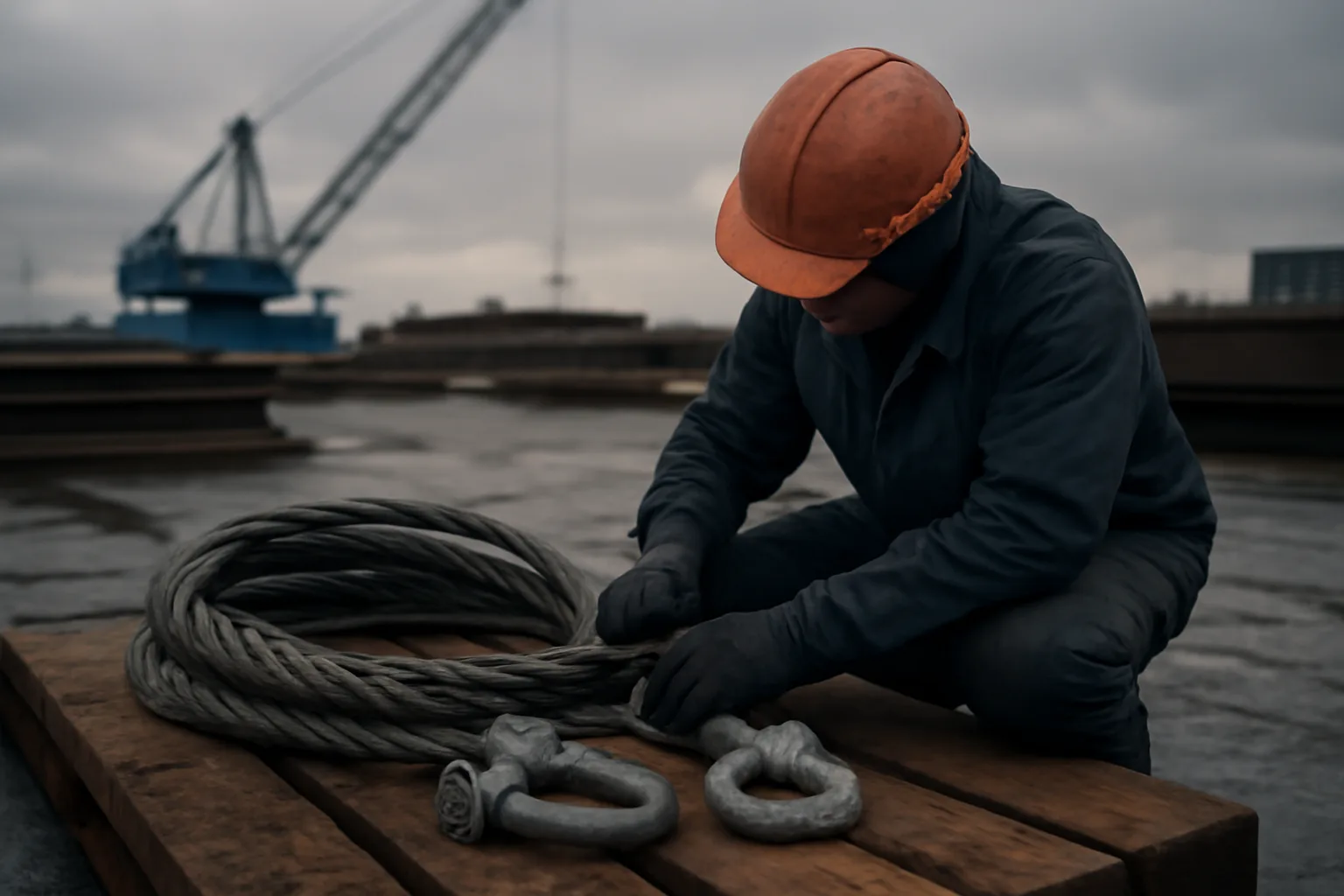
A rigger hitches and inspects loads. Federal OSHA does not license the trade. It requires a qualified rigger for crane assembly and disassembly, and when people stand in the fall zone to hook or guide a load. You start on a crew, document training, and add NCCCO or a city card only where a board actually issues one. Confirm fees and forms with that board.
What is a rigger?
A rigger picks slings, shackles, hoists, and hitches, inspects that gear, and connects a load so a crane or hoist can move it without killing anyone. That is the whole job. On a steel floor you read the load, match hardware to weight and hitch, and stay on the radio with the operator.
The Bureau of Labor Statistics tracks this work under Riggers, SOC 49-9096. Those workers set up or repair rigging for construction, plants, logging yards, and ships.[7] The code is messy. It mixes shipyard gangs with shop maintenance and building work, and nobody has a clean public split of those groups. Pull the current Occupational Employment and Wage Statistics table if you want this year's median. Last year's wage does not automatically hold, so I will not quote it as gospel.
Construction lifts sit under OSHA's crane rule in 29 CFR 1926 Subpart CC.[15] Sling rules for general industry sit in 29 CFR 1910.184.[13] Construction material-handling rigging sits in 29 CFR 1926.251.[5] Shipyard and logging books are different again. If a salesperson tells you there is one national rigger rulebook, they are selling a seat in a classroom.
A useful rigger can look at a choker on a rebar bundle and tell you why it will slip. A weak rigger memorizes hand signals and still parks a synthetic sling on a sharp edge. The difference is not a laminated card. It is whether you can show, on that load, that you solved the problem.
Theatrical riggers hang points over audiences. Construction riggers hang steel over mud. Same physics. Different paper. Do not treat an entertainment card as proof you can pick a two-crane tailing hitch on a bridge girder.
How do you start as a rigger?
You start by getting onto a crew that already lifts, then proving you can inspect gear and hitch a load without guessing. There is no federal starter license. Most people enter through ironwork, millwright work, pile driving, boilermaking, shipyard labor, or a contractor willing to train you on live picks.
Get hired first. Then learn the reject criteria for wire rope, chain, and synthetics from 29 CFR 1926.251, and practice hitch types until you can explain why a basket is wrong for a slick load.[5] Write down every class, every competent-person talk, and every lift you helped plan. Employers ask for that file more than they ask for a story.
A registered apprenticeship is the cleanest trail if you can get indentured. The U.S. Department of Labor describes a registered apprenticeship as paid work plus related instruction under a written program.[14] Ironworker and millwright programs usually bury rigging inside the curriculum. You will not spend four years only on shackles. You will sling steel, bolt up, and still be the person who checks the tag on the sling.
Do not buy a weekend "certified rigger" seat before you have put a shackle on a load. The card expires in a drawer. If a general contractor later wants NCCCO Rigger Level I, take that exam after you have dirt on your gloves. If you will work in New York City or Washington, read that board's page before you pay anyone else. Fees and forms change. Confirm them there.
First-year money is mostly boots, a decent belt, and lost hours in the rain, not a pile of personal slings. For a cost map by line item, use the Rigger cost breakdown for people entering the trade. State boards also vary. California paper is not Alaska paper. Start with the state you will actually work in.
Does OSHA issue a rigger license?
No. Federal OSHA does not issue a rigger license and does not run a rigger exam. It requires a qualified rigger for certain lifts, and it leaves the proof to the employer.
OSHA's crane definitions say a qualified rigger "is a rigger who meets the criteria for a qualified person."[1] Qualified person, in 29 CFR 1926.32, means someone who by degree, certificate, professional standing, or "extensive knowledge, training, and experience, has successfully demonstrated his ability to solve or resolve problems relating to the subject matter, the work, or the project."[6]
The Qualified Rigger Fact Sheet is blunt. "Employers must use qualified riggers during hoisting activities for assembly and disassembly work (1926.1404(r)(1))."[2][4] The same sheet points at 1926.1425(c): a qualified rigger is required when workers are in the fall zone hooking, unhooking, or guiding a load, or making the initial connection of a load to a component or structure.[3][4]
That is an employer duty. It is not a wallet card from Washington, D.C. A superintendent can accept NCCCO, an in-house practical, or a union book if that person can actually solve the hitch in front of them. A random online certificate with no practical test is weak proof. I would not hang my name on it.
Assembly and disassembly of cranes is where new helpers get waved into work they should not touch. Read 1926.1404 before you put a hand on a pin.[2] If you cannot name the manufacturer procedure, you are not the qualified rigger on that task.
What paper do employers actually ask for?
Employers ask for proof you are a qualified person on the hitch you are about to make. On federal-only jobs that proof is a training record, a practical evaluation, and a supervisor who will stand behind you. On many commercial sites it is an NCCCO Rigger Level I card because the GC's insurance desk knows that name.
OSHA never says "NCCCO only." It says qualified. Contractors still short-list known programs because an auditor can check them. NCCCO publishes Rigger Level I and Rigger Level II as separate certifications, each with written and practical exams.[8][9] NCCER and some union programs also issue rigger credentials. Confirm the current scheme with the body that prints the card. Do not trust a Facebook ad.
A signal person card is not a rigger card. OSHA splits those jobs. You can hold both. You should not claim one proves the other.
City licenses are a different pile. New York City issues Master Rigger and Special Rigger licenses through the Department of Buildings.[11][12] Washington writes rigger qualifications into WAC 296-155-53306.[10] Most states issue nothing with the word rigger on it. If a school says you need "the national rigger license," walk out.
Keep copies. Wallet card, score report, evaluator name, date, and the written lift plan if you made one. When a safety manager asks "who qualified you," you want a file, not a shrug. If you later chase independent work, ask a broker what rigger insurance they will even quote without that file.
What is NCCCO Rigger Level I versus Level II?
NCCCO Rigger Level I is the basic national certificate most GCs mean when they say "get your rigger card." Level II is the harder practical for more complex rigging. Neither one is a government license.
Level I tests inspection, hitch selection, load control, and basic hardware. Level II goes further into load turning and more involved connections.[8][9] Exact outlines, eligibility, and fees sit on NCCCO's own Level I and Level II pages. Those numbers move. Confirm them there before you budget.
I would take Level I after a few months on a crew, not before your first day. The practical is where people who only watched videos fail. Level II can wait until you actually turn loads for a living. Paying for both on a dare is a waste if your shop only chokes bundles and shakes out mats.
If you want a paper checklist while you study lift plans and the NCCCO path, RiggerPath sells a $149 one-time NCCCO Rigger + Lift-Plan Kit at /start. Use it as a file, not as a substitute for a practical evaluator.
Recertification clocks are real. Do not let a card lapse and then argue you are still "basically certified." The auditor will not care. Pull the current recertification rule from NCCCO, not from a coworker who tested in 2014.
Which states and cities actually license riggers?
Most states do not license riggers. A handful of places put real paper on the trade. You have to read the local board, not a national blog.
New York City licenses Master Riggers and Special Riggers through the Department of Buildings. Those pages list who must apply, what the license covers, and how to start the application.[11][12] Experience rules and exam steps change. Confirm every item on the current DOB instructions. I will not invent a year-count or a fee.
Washington writes rigger qualifications into WAC 296-155-53306 under the crane rule in Chapter 296-155.[10] That is state code, not a suggestion. L&I is the agency that will tell you which cards they accept this year. Call them or read the current WAC text before you buy a class in another state and hope it ports.
California has a thick crane and construction book, and a contractor board, but that is not the same as a statewide "rigger license" you hang on the wall. Check the rigger board in california before you spend money. Florida, Georgia, and most of the South work the same way: OSHA qualified person plus whatever the GC wrote into the site-specific plan. See the rigger board in florida if that is your market.
Alaska and other owner-heavy markets sometimes add project rules on top of OSHA. Confirm with the rigger board in alaska and with the owner. A North Slope orientation is not a substitute for knowing 1926.1404.
| Place | What actually exists | Who confirms it |
|---|---|---|
| Federal OSHA | Qualified rigger duty, no license | 29 CFR 1926.1404 and 1926.1425 |
| NCCCO | Level I and Level II certificates | nccco.org program pages |
| Washington | Rigger qualifications in WAC 296-155-53306 | L&I and the WAC text |
| New York City | Master Rigger and Special Rigger licenses | NYC Department of Buildings |
| Most other states | No rigger license | The state board page for your jobsite |
What does first-year rigger work look like?
First-year work is inspection, simple hitches, and staying out of the fall zone until someone qualified wants you on the hook. You will spend more time wiping grease off pins than designing a multi-crane pick.
Expect mats, bundles, gang boxes, and the same four sling types until your hands know the tags. 29 CFR 1926.251 requires inspections and removal from service when you see the listed defects.[5] Your job is to find those defects before the operator booms up. If the tag is missing and you cannot prove capacity, park the sling.
You will also get coffee and flagging duty. Take it. The operator who trusts you with a four-leg bridle later is the one who watched you keep people out from under the headache ball in month two.
Lift plans on small jobs are often a whiteboard and a weight the delivering trucker read off a bill. Treat that number as a rumor until you confirm it. Nobody has clean public data on how often trucker weights are wrong. The honest habit is to weigh it, calculate it, or call an engineer when the load is ugly.
If the crane is being assembled, stop. 1926.1404(r) wants a qualified rigger on those hoists.[2] A helper who "just hooks the counterweight" is how people get crushed. Walk away and get the person named in the A/D plan.
How much does it cost to get started as a rigger?
The honest answer is that your first-year bill is local, and anyone quoting a single national number is guessing. Exam fees, union books, and city licenses change. Confirm each line with the board or the certifying body.
Federal OSHA does not charge you for a rigger license because it does not sell one. NCCCO charges for testing and recertification. Those figures live on NCCCO's pages, not in this article.[8][9] A city Master or Special Rigger license in New York has its own application path and costs on the DOB site.[11][12]
Training can be free inside a registered apprenticeship or an employer program.[14] Paid short courses exist. Some are decent practicals. Some are a slideshow and a printer. If there is no hands-on evaluation, I would not pay.
Personal tools should stay small in year one. The contractor owns the slings. You own PPE that fits. For a line-item walkthrough, use the Rigger cost breakdown. California and Connecticut first-year stacks look different. Compare what rigger cost in California looks like your first year with Rigger cost in Connecticut if you are choosing a market.
Insurance is not a beginner line unless you go independent. Employees are usually on the contractor's policy. Owner-operators are not. Read what rigger insurance really costs before you print invoices.
Do you need an apprenticeship to become a rigger?
No. You can become a working rigger without a registered apprenticeship. An apprenticeship is still the cleanest way to get paid while someone documents your hours.
A registered program is a written bargain: wage progression, related instruction, and on-the-job supervision.[14] Ironworkers, millwrights, boilermakers, and some shipyard trades already teach rigging inside that bargain. You apply to the trade, not to a standalone "rigger college."
Nonunion shops hire helpers every week. The risk is uneven teaching. One foreman will show you how to read a sling angle. The next will throw you a chain and walk off. If you go that route, keep your own log. Dates, loads, hardware, who evaluated you. That log is how you later sit for NCCCO or answer an OSHA investigator.
I would take a registered slot if one is open in commuting distance. I would not sit unemployed for two years waiting on a perfect indenture while construction is hiring. Competence on the hook beats a brand-name program you never entered.
Entertainment is its own door. IATSE and venue shops do not run on NCCCO. Do not assume a construction Level I gets you on a truss over a crowd.
What gear should you buy in year one?
Buy PPE that fits and a way to write things down. Do not buy a garage full of slings. The contractor should issue inspected gear. If they want you to show up with your own four-leg bridle, you are not on a serious lift crew.
A hard hat, rated glasses, gloves you can actually feel wire with, and boots that survive rebar. That is the starter kit. Add a marker, a pocket notebook, and a phone folder for photos of tags and defects. 1926.251 is an inspection rule. Photos help you show you pulled a sling before it parted.[5]
Skip the engraved "rigger" belt buckle and the $80 hitch poster. Skip personal chain slings until you know removal criteria cold. A helper-owned sling with no inspection record is a gift to a plaintiff's lawyer.
If you later go independent, hardware buying changes, and so does insurance. Stay on company gear until that day. Confirm any owner-operator rules with the project and with your broker. Do not invent a capacity tag with a paint pen. That is how people get fired, or worse.
How do you prove you are a qualified rigger on paper?
You prove it with a file that shows knowledge, training, and a successful demonstration on the kind of problem in front of you. That is the text of OSHA's qualified-person definition, not a slogan.[6]
Put these in one folder. Training roster or course certificate. Evaluator name and date for a practical. NCCCO or other third-party card if you hold one.[8] Employer letter that says you are authorized to rig listed load types. Photos or copies of inspections you performed under 1926.251.[5] Any city or state license if you work where one exists.[10][11]
The demonstration matters more than the letterhead. OSHA's fact sheet ties the qualified rigger to assembly and disassembly hoists and to people in the fall zone.[4] If your file only shows a slideshow quiz, you are not ready for those tasks.
I would refuse to sign a lift plan as the rigger if I cannot show that file. Superintendents forget that the name on the plan is the name an investigator calls. Be boring. Be documented.
What mistakes get new riggers hurt or fired?
Guessing at weight is the classic. The second is standing in the fall zone to "just steady it" when you are not the qualified rigger under 1926.1425.[3] The third is using gear with a missing tag.
Side loading a shackle, tip-loading a hook, and choking a synthetic on an unspread edge show up in the same incident reports year after year. 1910.184 and 1926.251 both care about inspection and proper use.[5][13] You do not need a journal article to know a cut sling is done. You need the spine to scrap it.
On the paper side, the firing offense is claiming a license you do not have. Saying you are "city licensed" in a state that has no rigger license is stupid. Saying you hold NCCCO Level II when you sat Level I is worse. Boards and certifying bodies will confirm.
Phones under the hook get people run over. Put the phone away until the load is down and the operator has the all-clear. That is not written into a statute as a phone rule. It is still how helpers die.
Where do you look up your local board before you pay anyone?
Look up the state or city page that actually prints licenses, then look up OSHA for the federal floor. Pay a school only after those two tabs are open.
Start with 29 CFR 1926.1401, 1926.1404, and 1926.1425 so you know what "qualified rigger" means on a construction crane.[1][2][3] Then open your state labor or licensing site. Washington's text is WAC 296-155-53306.[10] New York City's text is on the Master Rigger and Special Rigger license pages.[11][12] If your state has no rigger license, stop looking for one.
Use the state board guides when you need a local map. The rigger board in connecticut is not interchangeable with California or Alaska. Confirm fees, forms, and whether a card even exists. Nobody here can freeze a board's price list.
RiggerPath is an independent publisher, not a law firm and not a service company. If you want the $149 one-time NCCCO Rigger + Lift-Plan Kit after you have read the primary pages, it is at /start. The regulations still win. Read them.
Frequently asked questions
What is a rigger?
A rigger inspects slings and hardware, chooses the hitch, and connects a load to a crane or hoist. Federal OSHA treats this as qualified-person work on construction cranes, not as a federal license. BLS tracks the occupation as Riggers, SOC 49-9096, across construction, plants, yards, and ships.
How do you start as a rigger?
Get hired onto a lifting crew, learn inspection and hitches, and keep a written training file. There is no national starter license. Add NCCCO Rigger Level I if employers ask, and add a city or state card only where a board issues one. Confirm current forms with that board before you pay a school.
Is rigger a licensed trade in the United States?
Not at the federal level. OSHA requires a qualified rigger for certain crane tasks but does not license the trade. New York City issues Master Rigger and Special Rigger licenses. Washington writes rigger qualifications into WAC 296-155-53306. Most states issue no rigger license at all.
Do I need NCCCO to work as a rigger?
OSHA does not require NCCCO by name. Many general contractors still ask for NCCCO Rigger Level I because they can verify it. Level II is for more complex work. Check the current NCCCO Level I and Level II pages for eligibility and fees before you schedule. An employer practical can also meet the qualified-person test.
What is a qualified rigger under OSHA?
A qualified rigger is a rigger who meets OSHA's qualified-person criteria. That means a degree, certificate, standing, or extensive knowledge, training, and experience, plus a shown ability to solve the actual rigging problem. OSHA requires that person for assembly and disassembly hoists and when workers are in the fall zone hooking or guiding a load.
How long does it take to become a rigger?
You can hitch simple loads under supervision within weeks on a busy crew. Becoming the person named on a lift plan takes longer, and nobody publishes an honest national average. A registered apprenticeship spreads the learning across a full trade program. City licenses add their own experience gates. Confirm those gates with the board that prints the card.
Can I start rigger work at 18?
Most construction employers will not put a minor on a crane crew, so this is adult work in practice. Confirm age rules with the employer, the union, and any city license you need. OSHA's qualified-person test is about demonstrated ability, not a birthday, but sites still set their own minimums. Do not guess. Ask in writing.
What is the difference between a rigger and a signal person?
A rigger selects and inspects the gear and makes the connection. A signal person directs the operator when the operator cannot see the load or the path. OSHA treats them as separate competencies. You can hold both. A signal card does not prove you can choose a hitch or scrap a damaged sling.
Do theatrical riggers need the same card as construction riggers?
Usually no. Construction sites lean on OSHA Subpart CC and often on NCCCO. Theatres and tours use venue rules and entertainment credentials. The physics overlap. The paper does not. Do not walk onto a steel erection floor with only a stage card, and do not hang a truss over a crowd with only a construction Level I unless the venue accepts it.
Is rigger work union or nonunion?
Both. Ironworkers, millwrights, boilermakers, and shipyard trades run a lot of the union rigging. Plenty of nonunion contractors hire helpers and train in-house. Pay, hours documentation, and who evaluates you will differ. The OSHA qualified-rigger duty does not change with the union bug.
What insurance do independent riggers carry?
Employees usually sit on the contractor's coverage. Independent riggers need their own policy, and brokers will ask for your qualifications file before they quote. There is no single national premium I can cite without lying. Confirm required coverages with the project and a licensed broker. Start with a clear written scope so the policy matches the lifts.
Can I become a rigger with a felony?
Federal OSHA does not run a rigger background check because it does not license you. Employers, unions, ports, and city license boards set their own rules. A DOB or port credential can ask questions a shop helper job will not. Read the application you are actually filing. Do not assume a conviction ends every path, and do not assume it ends none.
Sources
- OSHA 29 CFR 1926.1401 Definitions: Defines qualified rigger as a rigger who meets the criteria for a qualified person
- OSHA 29 CFR 1926.1404 Assembly/Disassembly: 1926.1404(r) requires a qualified rigger during hoisting activities for assembly and disassembly work
- OSHA 29 CFR 1926.1425 Keeping clear of the load: 1926.1425(c) requires a qualified rigger when workers are in the fall zone hooking, unhooking, or guiding a load
- OSHA Qualified Rigger Fact Sheet: Employers must use qualified riggers for A/D hoisting and when workers are in the fall zone hooking or guiding a load
- OSHA 29 CFR 1926.251 Rigging equipment for material handling: Sets inspection, removal-from-service, and use rules for slings and rigging equipment in construction
- OSHA 29 CFR 1926.32 Definitions: Defines qualified person by degree, certificate, standing, or extensive knowledge, training, and experience plus demonstrated ability
- BLS OEWS Riggers SOC 49-9096: BLS classifies Riggers under SOC 49-9096 and publishes current employment and wage estimates for the occupation
- NCCCO Rigger Level I certification page: NCCCO issues a Rigger Level I certification with written and practical examination requirements published by NCCCO
- NCCCO Rigger Level II certification page: NCCCO issues a separate Rigger Level II certification for more complex rigging work
- Washington WAC 296-155-53306 Rigger qualifications: Washington state code sets rigger qualifications for crane-related construction work
- OSHA 29 CFR 1910.184 Slings: General industry sling standard covering inspection and use of slings
- OSHA 29 CFR 1926.1400 Scope: Establishes the scope of OSHA's construction cranes and derricks rule, Subpart CC