Last updated 2026-08-20
TL;DR
The hardest places for a rigger are the few that still issue a rigger or hoisting license on top of OSHA's qualified-rigger rule. New York City is its own class. California, Washington, Massachusetts, Connecticut, New Jersey, and Pennsylvania add extra crane paper. Most other states only need employer qualification and a lift plan the GC will accept.
What makes a state hard for a rigger?
Hard is extra paper. Not weather, not a grumpy superintendent, not a forum thread about summer steel.
Most of the country runs on one federal floor. OSHA's construction crane standard requires a qualified rigger, and that duty has been in force since the rule took effect on November 8, 2010 [5]. OSHA's definition is short. "Qualified rigger is a rigger who meets the criteria for a qualified person" (29 CFR 1926.1401) [1]. Your employer has to be able to show it. A lot of GCs want an NCCCO card because it files cleanly. That still is not a state license.
A state gets hard when a second layer shows up. A city rigger license. A hoisting license that covers the machine you stand next to. A state-plan OSHA office that wrote its own rigger section. High workers' comp, plus a GC who will not let you near the hook without a local card. Those layers stack. That is what this article ranks.
I do not rank heat index. I rank paper you can confirm on a board site. If a video says Texas is brutal because July is hot, that is real work. It is not licensing.
Which states are the hardest for rigger work?
New York City is the hardest. Then California. Then Washington, Massachusetts, and Connecticut. New Jersey and Pennsylvania sit right behind them because they license crane operators, and that paper spills onto every small crew. Most other states are OSHA-only.
Nobody publishes an official hardest-rigger-state list. The closest honest method is counting extra licenses a new rigger actually hits in year one. I used board-confirmable rules, not vibes.
| Rank | Place | Extra paper a new rigger hits | Confirm with |
|---|---|---|---|
| 1 | New York City | Master, Special, and climber/tower-crane rigger licenses | NYC DOB [6] |
| 2 | California | Cal/OSHA Title 8 crane and sling rules, certified operators | DIR / Cal/OSHA [7] |
| 3 | Washington | WAC 296-155-53306 rigger qualifications | L&I / Code Reviser [8] |
| 4 | Massachusetts | Hoisting machinery license classes | Mass DPS [9] |
| 5 | Connecticut | Hoisting equipment operator license | CT DCP [10] |
| 6 | New Jersey | Crane operator license | NJ DOL [11] |
| 7 | Pennsylvania | Crane operator license (Act 100 of 2008) | PA General Assembly / L&I [12] |
Hawaii belongs in the conversation if you count isolation, rent, and a tiny market. It is a hard place to live as a rigger. It is not NYC-hard on licenses. Alaska pays. The plane ticket and the weather stop more people than the paperwork.
If you want a lighter first year of hours, start where the state is not inventing a rigger card. How to start rigger work in Alabama is a different animal than a DOB application.
Why is New York the hardest place to work as a rigger?
NYC is the only big U.S. market that still treats rigging as its own licensed trade. The Department of Buildings issues Master Rigger, Special Rigger, and Climber or Tower Crane Rigger licenses [6]. If you hoist on the outside of a building in the five boroughs, you are in that system. A national NCCCO card does not replace those city licenses.
NYC Department of Buildings issues three rigger licenses: Master Rigger, Special Rigger, and Climber or Tower Crane Rigger [6]. The city has long required documented practical experience plus a department exam. Read the current application packet. Boards change forms. I will not quote a fee or a wait time, because a stale number is how people blow a season.
Special Rigger is the card a lot of smaller outfits chase. Master Rigger is the heavy one. Tower-crane rigger is its own lane. Mixing them up on a bid is how you get walked off a deck.
Outside the city, most New York construction rigging still sits under OSHA. The trap is thinking "New York" means Albany rules. It does not. The hard paper is municipal. If your work is upstate steel and you never touch a NYC permit, you are not in the same fight.
I'd treat NYC as an apprenticeship-plus-license market, not a weekend cert market. If you cannot get on a crew that already holds the license, the exam is not your first problem. Hours are.
How hard is California for rigger work compared with other states?
California does not issue a statewide rigger license the way NYC does. That surprises people who moved for "the hardest license." The hardness is everything around the hook.
Cal/OSHA makes crane operators hold certification under Title 8 section 5006.1 [7]. The same Title 8 book has detailed crane, hoist, and sling rules. Inspectors actually show up. A qualification file that would pass a sleepy federal-OSHA state can fail a Cal/OSHA visit if the employer cannot explain how they qualified you for that hitch.
Workers' compensation is expensive. General contractors in the Bay Area and Los Angeles write lift plans like legal briefs. Cities add street-use and encroachment permits when a mobile crane sits in a lane. None of that is a rigger card. All of it slows first-year people.
If California is the target, use a state guide, not a national myth. How to start rigger in California and rigger license in California walk the actual paper. Rigger renewal in California matters once a cert clock is running.
I would not move to California for easier licensing. There is no easier licensing prize. Move there for the hours, or stay put.
Does Washington require a rigger license?
No statewide rigger license. Washington did something almost as sticky. It wrote rigger qualifications into the Washington Administrative Code, where an inspector can cite them by number.
Washington wrote rigger qualifications into WAC 296-155-53306, which is a state rule you can look up by number [8]. It sits next to the state's crane, signal person, and lift director rules. L&I will ask who the rigger is. "My boss said I'm good" is not a file.
Washington is a state-plan OSHA state, so you answer to L&I, more than federal OSHA. That is the practical difference. The questions look like OSHA's qualified-person test. The enforcement culture is tighter on documentation.
If you already keep a clean packet (training record, experience, a practical evaluation, the lift plan with your name on it), Washington is doable. If you have been winging it, the first L&I visit will feel personal. Keep paper. Phone photos of cards die.
Are Massachusetts, Connecticut, and New Jersey as hard as people say?
They are hard in a different way. They license the hoisting side so tightly that a rigger who also handles the machine, or who works on a two-person crew, hits a license wall.
Massachusetts hoisting machinery licenses live under 520 CMR 6, and you apply through the state's hoisting process [9]. Class matters. The wrong class on your person is a stop-work. Connecticut's Department of Consumer Protection runs hoisting equipment operator licensing [10]. New Jersey licenses crane operators through Labor and Workforce Development [11]. Pennsylvania does the same under the Crane Operator Licensure Act, Act 100 of 2008 [12].
None of those four is a pure rigger-license state. Here is the catch. A lot of first-year rigging jobs are on small contractors where the same two people sling the load and run the lever. If you cannot legally run the hoist, you are less employable. That is why they sit in the hard column even though the word on the card says operator.
Connecticut's path is its own pile of forms. How to start a rigger career in Connecticut and rigger license in Connecticut are the honest versions, not a recycled national checklist.
I'd get the hoisting class your actual contractor uses before I paid for a random advanced-rigging weekend. The board does not grade your weekend.
What is a rigger?
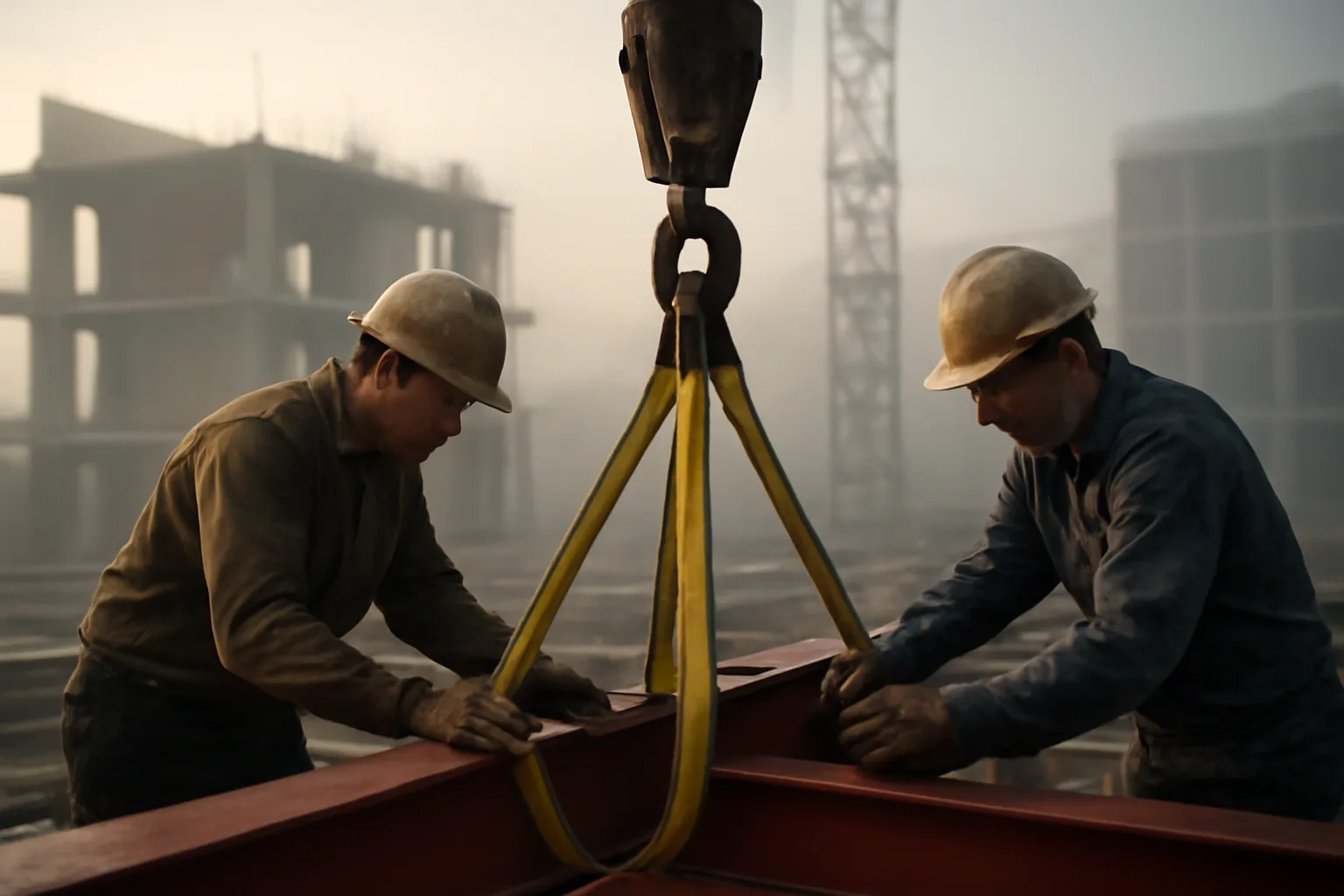
A rigger selects and inspects slings, shackles, hardware, and below-the-hook gear, then hitches the load so a crane or hoist can move it without killing someone. That is the job. Steel, precast, HVAC units, transformers, boats, scenery. Same physics. Different GCs.
OSHA does not license you. OSHA makes the employer use a qualified rigger when the rule is triggered. The rule is triggered during assembly and disassembly of a crane, and when a worker has to be in the fall zone to hook, unhook, or guide a load [2][3]. OSHA's qualified-rigger fact sheet states the triggers in plain language: "Employers must use qualified riggers during hoisting activities for assembly and disassembly work (1926.1404(r)(1))." The same sheet says "qualified riggers are required whenever workers are within the fall zone and hooking, unhooking, or guiding a load, or doing the initial connection of a load to a component or structure (1926.1425(c))" [4].
The same definitions section also says who counts as qualified. A qualified person is "a person who, by possession of a recognized degree, certificate, or professional standing, or who by extensive knowledge, training and experience, successfully demonstrated the ability to solve/resolve problems relating to the subject matter, the work, or the project" [1]. That sentence is the whole federal license, such as it is.
People mix up rigger, signal person, and operator. Different tasks. Sometimes one human holds more than one qualification. The lift plan should say who is who. Training duties for those roles sit in 29 CFR 1926.1430 [14]. BLS tracks the occupation under SOC 49-9096. That code is useful for wage tables. It is not a license.
How do you start rigger work in a hard state?
You start on a crew, not on a website. Get hired as a helper or apprentice where someone already holds the local card. Log the work. Take the signal person path in parallel, because most sites want both. Sit the exam the board actually writes, if the board writes one.
In an OSHA-only state the start is simpler. Employer qualification, a written test some GCs like, a practical with slings you will really use, and your name on a lift plan. NCCCO Rigger Level I is the card that travels. OSHA does not require NCCCO by name [1][4]. Employers do.
If you want a single binder for the NCCCO written and a lift-plan packet, RiggerPath sells a $149 one-time NCCCO Rigger + Lift-Plan Kit at /start. You do not need it to be legal. You need a qualification file your employer can defend.
Do not buy a "state rigger license" course for a state that does not issue that license. That product exists. It is a waste of money. Confirm the license list on the state site first. Starting in Alaska will not look like NYC, and anyone selling you the same stack for both is guessing.
Hard-state version, in order: hire, hours, employer eval, the local card if one exists, then the traveling cert. Reverse that order and you will own laminated plastic that no superintendent asked for.
Do you need NCCCO if your state has no rigger license?
Need is doing a lot of work in that sentence.
OSHA needs a qualified rigger, not a branded card [1]. NCCCO Rigger Level I and Level II are national certification programs with written and practical exams [13]. Plenty of owners and GCs write "NCCCO or equivalent" into the site-specific lift plan. Then you need it for that gate, not for the state.
In NYC, NCCCO still does not replace the DOB rigger license [6]. In California, it helps the qualification file and it does not replace operator certification under Title 8 section 5006.1 [7]. In Washington, it is strong evidence under WAC 296-155-53306. It is not a substitute for an employer evaluation if L&I asks how you were qualified for that load [8].
I'd get NCCCO Level I if I planned to travel. I'd get Level II if I was making hitch selections, more than following a senior rigger's call. I would not collect extra vendor cards to feel busy. One good practical on the gear you actually use beats four expired PDFs.
What does first-year paper look like in a hard state?
Year one is ugly. Expect a driver license, an I-9, a drug screen, OSHA 10 or 30 (site rule, not a rigger license), employer orientation, a rigger qualification record, a signal person qualification, and whatever the crane company wants before you touch their nylon.
In NYC, add the DOB license track or work only under a licensed rigger's supervision in the way the code allows [6]. Confirm supervision rules with the department. Do not take a Reddit version of "I can do it if he is on the block."
In Massachusetts or Connecticut, add the hoisting class if your job includes running equipment [9][10]. In New Jersey or Pennsylvania, the operator license is the bottleneck on small crews [11][12]. Federal training rules in 1926.1430 still apply on top of those state cards [14].
Insurance is the silent paper. Licensed NYC riggers carry what the city and the GC require. I will not invent a premium. Ask a construction insurer who already writes rigger or crane accounts in that city. If they will not quote you, that is data.
Keep copies in a folder you control. Evaluations, the hardware you were signed off on, and the lift plans you signed will save you when an inspector asks who qualified you. A screenshot in a group chat will not.
Which states are easier for a rigger, and is easier worth it?
Easier paper is most of the South, the Plains, and a lot of the Mountain West. Alabama, Arkansas, Arizona, and similar states generally run on OSHA qualification plus the GC. That is not the same as easy work. It is easier licensing.
Rigger license in Colorado is a middle case. Growing work, federal OSHA, GCs who still want tidy cards. Useful if you want hours without a city rigger board.
Is easier worth it? If you need to get paid this quarter, yes. Sit where a contractor will put you on the hook under an employer qualification. Build a logbook. Then decide if NYC or California hours are worth the board fight.
I would not move to a hard state just to look serious. Move because the jobs are there. Empty toughness is expensive. A year of logged hitches in a light-license state will beat a year of waiting on a city experience clock with no sponsor.
How much extra does a hard state cost a new rigger?
I will not invent exam fees or processing times. Boards change both. Confirm every dollar on the current fee schedule for that board.
The real extra cost is time. A city rigger license with a multi-year experience gate means you earn helper wages longer. A hoisting license means nights in a prep class for a machine you may only run twice a month. Higher workers' comp states take a bite out of small shops, which means fewer people willing to hire a green rigger.
Travel and housing in NYC, the Bay Area, Seattle, Boston, and Honolulu will dwarf any exam fee you eventually pay. That is the part people skip in comment threads.
If you are stacking certifications, buy the ones a named employer asked for. A kit from RiggerPath at /start can organize NCCCO and lift-plan paper. It will not buy a DOB license and it will not shorten a statutory experience clock. RiggerPath is an independent publisher, not a law firm and not a licensing agency. No one here can promise you a pass date. Anyone who does is selling something other than the truth.
Frequently asked questions
What is a rigger?
A rigger inspects slings and hardware, chooses the hitch, and attaches the load so a crane or hoist can move it safely. OSHA treats the role as a qualified-person job under 29 CFR 1926.1401, not as a federal license. Signal person and operator are separate qualifications. One person can hold more than one if the lift plan says so.
How do you start rigger work?
Get on a crew as a helper, log real hours, and have your employer document a qualification (training, experience, and a practical). Add a signal person qualification. Get NCCCO Rigger Level I if you want a card that travels. In NYC or a hoisting-license state, also follow that board's exam and experience rules. Confirm every local card on the board site before you pay a school.
Is there a national rigger license in the United States?
No. OSHA requires a qualified rigger on covered lifts. It does not issue a national rigger license. NCCCO Rigger Level I and II are private certifications that many employers accept as proof. A handful of cities and states add their own rigger or hoisting licenses. Those local cards are what make a place hard.
Does California issue a rigger license?
No statewide rigger license. Hardness comes from Cal/OSHA Title 8 crane and sling rules, certified operators under section 5006.1, expensive workers' comp, and GCs who want a thick qualification file. Confirm current operator-cert rules with DIR. Do not buy a course that pretends California prints a rigger card like NYC.
Do I need a rigger license in Texas or Florida?
Neither state runs a general rigger license like NYC. You still need to be a qualified rigger under OSHA 29 CFR 1926 Subpart CC when the rule is triggered. Some cities add crane permits for the machine, not a personal rigger card. Confirm jobsite and municipal crane rules with the employer before you assume zero paper.
Does OSHA require NCCCO rigger certification?
No. OSHA requires a qualified rigger, defined as a rigger who meets the qualified-person test in 29 CFR 1926.1401. NCCCO is one way employers document that. It is not named as the only way. Many GCs still write NCCCO or equivalent into the lift plan, which makes the card a gate even when the state does not care.
How long does a NYC master rigger license take to get?
Nobody should quote a processing time as a promise. The long part is the experience the Department of Buildings requires before you even sit the exam, plus whatever queue the current application packet describes. Read the live DOB rigger page and the application instructions. RiggerPath does not guarantee approvals or dates.
What is the difference between a qualified rigger and a certified rigger?
Qualified is the OSHA word. It means your employer can show knowledge, training, and experience for that load. Certified usually means a third-party card such as NCCCO Rigger Level I or II. Certification can support qualification. It does not automatically satisfy a city rigger license, and it does not replace a state hoisting or crane-operator license.
Are union states harder for new riggers?
Union density can slow a cold start if the hall controls the good hours. That is access, not a statute. The paper that is actually hard is still NYC DOB, Cal/OSHA files, Washington's WAC rigger rule, and the hoisting or crane-operator boards in Mass, Connecticut, New Jersey, and Pennsylvania. A non-union shop in those places is not a free pass around the board.
Which state is easiest to start rigger work?
Any federal-OSHA state with no rigger or hoisting license and a contractor willing to qualify you. A lot of the South and Plains fit that description. Easiest paper is not easiest living, and it is not the highest pay. Use a light-license state to build a logbook, then take those hours to a harder market if you want that work.
Do I need a signal person card if I am a rigger?
Often yes on real sites, even if you came to sling. OSHA separates the roles. Many GCs want both names filled on the lift plan. Washington writes signal person qualifications next to its rigger WAC. Get the signal qualification in parallel. It is cheaper than losing a week because nobody on the crew is documented to give hand signals.
Can I use an out-of-state rigger license in New York City?
Do not assume reciprocity. NYC issues its own Master Rigger, Special Rigger, and Climber or Tower Crane Rigger licenses through the Department of Buildings. A state hoisting card or an NCCCO cert does not replace those city licenses. Confirm any limited supervision or exemption language on the current DOB rigger page, not on a forum.
What should a first-year rigger qualification file contain?
Name, employer, dates, the training you sat, the gear you were evaluated on, a practical sign-off, and the lift plans that list you as rigger. Add signal person proof if you have it. Add NCCCO if you have it. Add the local license if the board issues one. Keep paper copies. A text thread is not a file an inspector will wait for.
What happens if I rig without being qualified?
The employer is on the hook under OSHA 1926.1404 and 1926.1425 when those sections apply. You can still be removed from the site, and a serious incident becomes a record you will not outrun. In NYC or a hoisting state, you can also be outside the local license. Do not test that. Get qualified on paper before you take the load.
Sources
- OSHA, 29 CFR 1926.1401 Definitions: Defines qualified rigger as a rigger who meets the criteria for a qualified person, and defines qualified person.
- OSHA, 29 CFR 1926.1404 Assembly/Disassembly: Requires a qualified rigger during crane assembly and disassembly hoisting activities.
- OSHA, 29 CFR 1926.1425 Keeping clear of the load: Requires a qualified rigger when workers are in the fall zone hooking, unhooking, guiding, or making the initial connection of a load.
- OSHA, Qualified Rigger fact sheet: States when employers must use qualified riggers under 1926.1404(r)(1) and 1926.1425(c) and restates the qualified-person test.
- Federal Register, Cranes and Derricks in Construction final rule (2010): OSHA published the construction cranes and derricks final rule on August 9, 2010, effective November 8, 2010.
- NYC Department of Buildings, Rigger licenses: NYC DOB issues Master Rigger, Special Rigger, and Climber or Tower Crane Rigger licenses.
- California DIR, Title 8 section 5006.1 operator certification: Cal/OSHA requires certification of crane and hoisting equipment operators under Title 8 section 5006.1.
- Washington State Legislature, WAC 296-155-53306 Rigger qualifications: Washington writes rigger qualifications into WAC 296-155-53306 as a citable state rule.
- Massachusetts, apply for a hoisting license: Massachusetts requires a hoisting machinery license process for covered hoisting equipment.
- Pennsylvania General Assembly, Act 100 of 2008: Pennsylvania enacted the Crane Operator Licensure Act as Act 100 of 2008.
- NCCCO, Rigger certification: NCCCO offers national Rigger Level I and Level II certification with written and practical exams.
- OSHA, 29 CFR 1926.1430 Training: Sets Subpart CC training duties for operators, signal persons, and competent or qualified persons.