Last updated 2026-08-21
TL;DR
A rigger inspects slings and hardware, chooses hitches, and connects loads so a crane can pick them. There is no U.S. national rigger license. OSHA requires a qualified person under 29 CFR 1926 Subpart CC. Most people start with employer training plus a written and practical exam such as NCCCO Rigger Level I. A few places add local paper. Confirm every fee and form with the board that issues it.
What is a rigger?
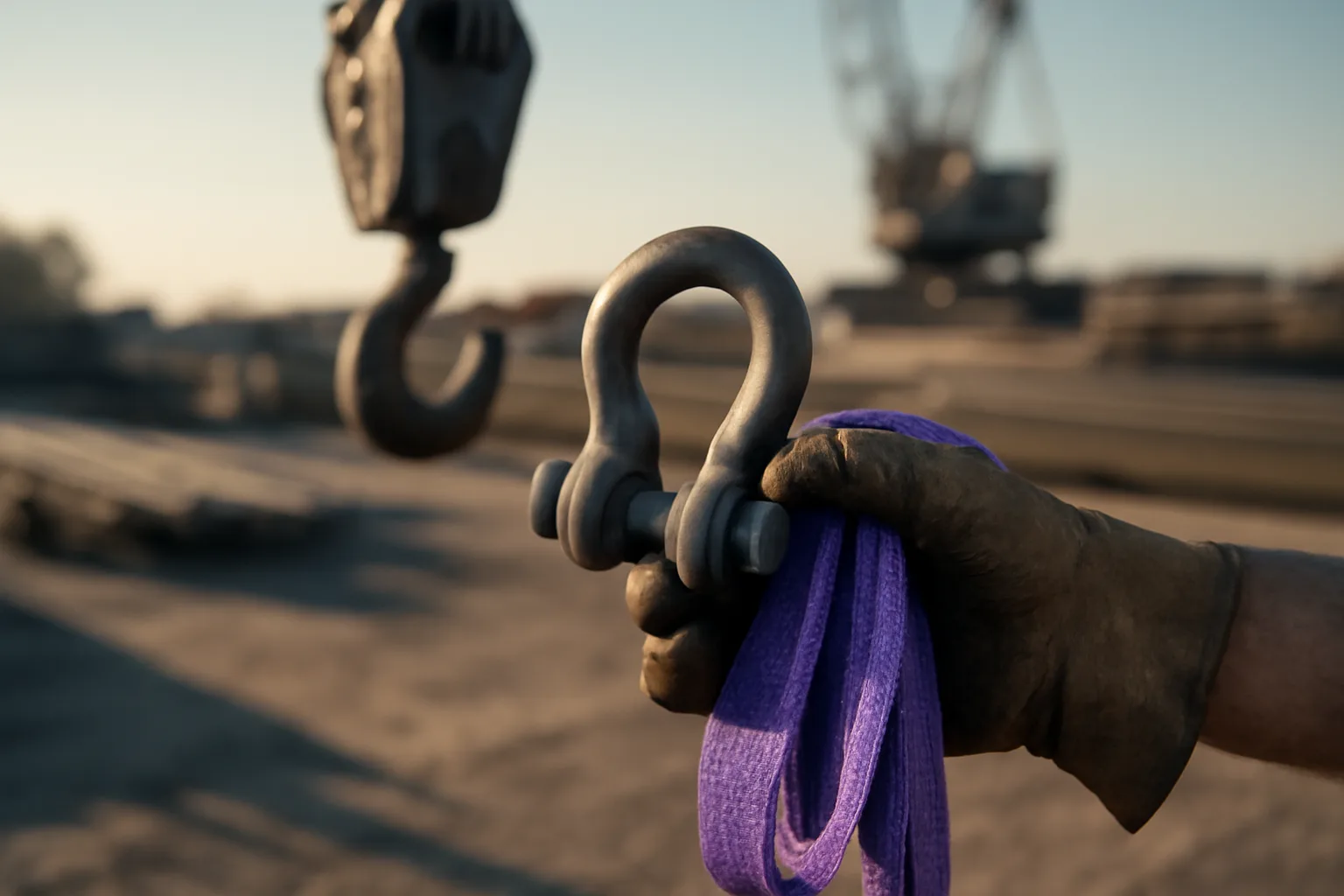
A rigger selects, inspects, and connects the slings, shackles, hooks, and hardware that tie a load to a crane or hoist. The rigger is not the crane operator. One person can hold both jobs, but only if they clear both qualification tests.
BLS tracks the trade as SOC 49-9096, Riggers. In May 2023 that group held 23,150 jobs at a median hourly wage of $27.79 [7]. O*NET lists the same code and describes work that includes attaching loads, choosing gear, and signaling when needed [14].
The job is load control. You read the weight, find the center of gravity, pick a hitch, check the sling angle, and stay out of the fall zone unless the rule lets you in. You reject damaged gear. You stop a lift that does not add up.
Vertical and choker hitches cover most simple work. A basket hitch shows up when the load can take the squeeze and the capacity math still works. If a sling angle drops under 30 degrees, I stop and rebuild the bridle. The force in each leg spikes, and nobody looks smart when a strap lets go.
Some crews use the word "rigger" for theater, film, or sail work. This article covers the construction and industrial crane path. That is the path with OSHA paper and, in a few cities, a real license. Shipyard and wind work run on the same physics. The employer name on the paycheck changes. The inspection habit does not.
How do you start as a rigger?
You start by getting qualified, not by mailing a national application, because there is no national rigger license. OSHA's test is whether you are a qualified person for the rigging you will do [1]. Employers make that call. They can train you in house, send you through a union apprenticeship, or ask for a third-party card such as NCCCO Rigger Level I [8].
Here is the path I would take if I were starting cold. Get a job or an indenture first. Ironworker, millwright, and crane-rental yards hire helpers who learn slings on real picks. Pair that with a written and practical rigger exam from a nationally accredited program. Keep every inspection form, training roster, and score report.
If you later work in New York City or Washington, you will need extra local paper. State start pages such as how to start rigger in california and how to start rigger in alabama walk those overlays. Same idea for how to start rigger work in Alaska and how to start rigger work in Colorado.
Do not buy a laminated card from a weekend class that never puts a sling in your hands. That card will not save you in an OSHA interview. It will not make you safe either.
You can work as a helper while you learn. OSHA does not ban trainees. The qualified rigger is required for the specific hooking and assembly tasks in 29 CFR 1926.1404 and 1926.1425 [2][3]. Stand next to that person. Take the next pick they will let you build. Write down what you did.
Do you need a national rigger license?
No. The United States does not issue a national rigger license. OSHA sets a performance rule, your employer documents that you meet it, and a few states and cities layer their own certificates on top. That is the whole map.
That gap is where the myth lives. People hear "you have to be certified" and picture a federal card. There is not one. 29 CFR 1926.1400 and the rest of Subpart CC tell employers when a qualified rigger is required. They do not name NCCCO, NCCER, or any other brand [12].
If a job spec says NCCCO rigger required, that is a contract term, not a federal statute. Honor it. Just know who wrote it.
New York City is the exception people actually bump into. The city licenses Master Riggers and Special Riggers through the Department of Buildings [10]. Washington State writes rigger qualifications into WAC 296-155-53306 [11]. California follows its Title 8 crane rules and still wants a qualified person, not a standalone statewide rigger license number [13]. Read rigger license in california before you assume a card from another state transfers.
Confirm the current form with the board that will stamp it. Rules move. I will not invent a processing time.
What does OSHA actually require for a qualified rigger?
OSHA requires a qualified rigger for two moments: when workers assemble or disassemble a crane, and when workers stand in the fall zone hooking, unhooking, or guiding a load. That is the federal trigger. It is not a license bureau.
The agency's own fact sheet states, "A qualified rigger is a rigger who meets the criteria for a qualified person." [4] 29 CFR 1926.1401 defines that person as someone who, "by possession of a recognized degree, certificate, or professional standing, or who by extensive knowledge, training, and experience, successfully demonstrated the ability to solve/resolve problems relating to the subject matter, the work, or the project." [1]
That is the whole federal test. A degree can do it. A certificate can do it. Long, documented experience can do it. The employer still has to explain the choice if OSHA asks.
29 CFR 1926.1425(c) is the load-handling line. When employees hook, unhook, or guide a load, or make the initial connection, and they are in the fall zone, "those employees must be qualified riggers." [3] Assembly and disassembly has its own line in 1926.1404, where the A/D director assigns a qualified rigger to the work that needs one [2].
OSHA also owns the hardware rules. 1926.251 covers construction rigging equipment, inspections, and removal criteria [5]. 1910.184 covers slings in general industry [6]. Read both before you argue with a competent person about a cut in a synthetic sling. If the webbing is melted, acid-burned, or the stitches are blown, it is out. Wire rope slings have their own removal counts in the same construction rule.
I treat those removal lists as hard stops. A "maybe it will hold" call is how people get hurt and how contractors get cited.
Is NCCCO rigger certification required?
Not by OSHA. NCCCO Rigger Level I and Level II are voluntary national certifications. Plenty of owners and contractors write them into bids because the written and practical exams are a clean way to show qualification.
NCCCO Rigger Level I tests basic selection, inspection, and hitch work. The written exam has 60 multiple-choice questions and a 60-minute limit [8]. Level II adds harder load control and its own separate written and practical [9]. Certification runs five years, then you recertify. Confirm current fees on NCCCO's published fee schedule. I will not quote a dollar figure here, because those fees change and I am not the certifying body.
Is it worth it? If you want to travel between contractors, yes. If your only shop trains and documents you well, you can work legally without it on a plain OSHA site. I would still sit the Level I practical. The hands-on test finds people who can name hitch types but cannot build one.
NCCER and some union programs issue their own rigger credentials. Same idea. Pick one recognized program and finish the practical. Two overlapping cards in year one is usually a waste.
If you want a study checklist and lift-plan templates in one place, RiggerPath sells a $149 one-time NCCCO Rigger + Lift-Plan Kit. The kit does not replace the exam or any board filing. Use it or skip it. The OSHA rule does not care which binder you bought.
How long does it take to become a rigger?
You can be useful on simple picks in weeks if a competent person stands over you. You are not a finished rigger then. Judgment runs slower than a card.
A registered apprenticeship in a related craft (ironworker, millwright, boilermaker) often runs three to four years and folds rigging into the related instruction [15]. A short rigger course plus a practical exam can take a few days of class and one test date. The card is not the same thing as knowing when to refuse a lift.
Nobody has clean national data on time to first unsupervised lift. The closest public snapshot is employment and wage, not a training clock [7]. Plan on 40 to 80 hours of serious classroom and yard time to sit Level I without guessing, then months of real lifts before you should call loads on your own.
If someone promises you fully qualified in one Saturday, walk. That pitch sells plastic. It does not build a rigger.
How much does a rigger make?
BLS recorded 23,150 rigger jobs in May 2023 with a median wage of $27.79 an hour (BLS OEWS, SOC 49-9096) [7]. The mean was $30.23 an hour, or $62,880 a year. The bottom tenth sat near $18.11. The top tenth cleared $47.13.
Those numbers mix shipyard riggers, construction riggers, and industrial plant hands. Union ironworker scale in a coastal city beats the median. A helper in a low-cost market sits under it. Recheck the current OEWS table before you quote a figure in a wage talk, because BLS revises the file every year.
Overtime and per diem matter more than the posted rate on travel jobs. Ask how they pay drive time before you celebrate the hourly. Ask who supplies slings. A shop that hands you junk gear is not paying you well, no matter what the stub says.
Do not treat BLS as your offer letter. It is a national snapshot. Your local hall or the crane-rental yard has the number that actually hits your account.
Which states actually license riggers?
Most states do not. They lean on OSHA or a state-plan clone and leave qualification to the employer. That is the normal U.S. pattern, not a loophole.
New York City licenses Master Riggers and Special Riggers through the Department of Buildings. That is a real municipal license with experience, exams, and insurance behind it. Special Rigger is the limited ticket. Master Rigger is the broader one. Confirm the current scope, experience affidavit, and fee on the Buildings license materials before you file [10]. I will not invent a wait time.
Washington State writes specific rigger qualification rules in WAC 296-155-53306. The employer has to show that the rigger meets the listed training and competency items [11]. California does not run a standalone rigger license the way it runs contractor licenses. Cal/OSHA crane rules still require qualified people on covered lifts [13].
Alaska, Arizona, Arkansas, Colorado, Connecticut, and Alabama follow the same pattern: OSHA or state OSHA plus employer qualification, unless a city or owner adds a spec. See how to start a rigger career in Connecticut, rigger license in colorado, and rigger license in arizona before you budget for a phantom permit.
Always confirm with the board. A blog (this one included) is not the filing desk.
| Place | What you actually need | Who decides | Where to confirm |
|---|---|---|---|
| United States (OSHA) | Qualified person for the task | Employer | 29 CFR 1926 Subpart CC |
| New York City | Master or Special Rigger license | NYC DOB | Buildings rigger license packet |
| Washington State | Documented qualified rigger | Employer under WAC | WAC 296-155-53306 |
| California and most other states | Qualified person, plus any owner spec | Employer | State OSHA or OSHA |
What training and exams should you take first?
Take a rigger course that ends in a written exam and a practical exam. NCCCO Level I is the one I would sit first [8]. OSHA 10 or 30 is useful and often required by owners, but it is not rigger qualification by itself.
Learn sling capacities, D/d ratios, hitch efficiency, hardware identification, and the inspection removal criteria in 1926.251 and 1910.184 [5][6]. Signal person qualification is a separate OSHA item. Get it if you will give hand or voice signals. Do not blur the two cards in your head.
Keep the score report, the photo ID cert, and a log of lifts you worked. That log is what a future employer or a city license board will ask for. Skip lifetime certification vendors. Rigging standards change. A five-year recert cycle is a feature.
Study from the exam outline the certifier publishes. Random playlists miss the practical setup, and that is the part people fail.
What is the difference between Rigger Level I and Level II?
Level I is basic rigging. You identify gear, pick common hitches, inspect slings, and work under a lift plan someone else wrote. Level II is deeper load control. You handle uneven loads, more complex hardware, and planning work that Level I does not touch [8][9].
NCCCO Rigger Level I uses a 60-question written exam with a 60-minute limit (NCCCO Rigger Level I program page) [8]. Level II carries its own written and practical. Both run on a five-year cycle unless you recertify.
I would not sit Level II in month one. Pass Level I. Get a year of messy picks. Then take Level II if your work actually needs it. Paying for Level II so a resume looks taller is a common waste.
If your contractor only asks for Level I in the bid package, stop there until the work changes.
Can you start rigger work through an apprenticeship?
Yes, and it is the cleanest long path if you can get indentured. Ironworker apprenticeships teach hoisting and rigging as core related instruction. Millwright and some boilermaker programs do too. Registered programs sit on apprenticeship.gov and pay a progressive wage [15].
You will not only rigger. You will connect steel, set equipment, or maintain plants. That is fine. The hours count, and the classroom is already paid for. O*NET's rigger profile overlaps those crafts on tools, safety, and load handling [14].
If you cannot get into a program, hire on as a rigger helper or crane-yard hand and document every training hour yourself. The paper you fail to keep is the paper you will wish you had when a city license unit or a picky GC asks for proof.
I would take the indenture over a stack of short cards if both were on the table. The yard time is the point.
What paper should you keep on a rigger job?
Keep a qualification record, daily gear inspection notes, and the lift plan for anything that is not a simple, repetitive pick. OSHA's construction rigging rule expects defective gear pulled out of service [5]. If you cannot show that you looked, you did not look.
Your own inspection habit matters more than a branded bag. You need a way to check slings, shackles, hooks, wire rope, and synthetic wear. A load-weight method (shipping bill, calculated volume, or engineer sheet) has to exist before the hook goes on. The crane's load chart should be within reach of the crew, not in a truck across the yard.
I like a pocket capacity booklet and a wrenched understanding of sling angles. Fancy software is optional. A wrong angle is not.
Do not stamp a capacity on a homemade spreader and call it engineered. If it is a below-the-hook lifting device, it needs a real design trail. When in doubt, stop. Stopping is cheaper than a dropped load.
What first-year rigger mistakes waste money?
Buying three certs before your first job. Paying a recert coach before you have taken the first exam. Waiting for a state to mail you a rigger license it does not issue. Most will not.
The other waste is skipping the practical. Written-only cards crumple the first time a superintendent asks you to build a bridle on a load with a high center of gravity. A cheap class with no hardware on the floor is how people burn money.
RiggerPath is an independent publisher, not a law firm and not a service company. If you want the kit, it lives at /start. Confirm every fee, quota, and form with NCCCO or the local board. Nobody here can promise an approval date.
Work first. Test second. File local paper only where a board actually exists. That order saves cash and keeps you employable.
Frequently asked questions
What is rigger?
A rigger selects, inspects, and connects slings and hardware so a crane or hoist can pick a load. The rigger is not automatically the operator or the signal person. OSHA treats the job as qualified-person work under 29 CFR 1926 Subpart CC. BLS counts the occupation as SOC 49-9096.
How do you start rigger?
Get hired or indentured, train under a qualified person, and sit a written plus practical exam such as NCCCO Rigger Level I. There is no national rigger license. Keep score reports and lift logs. Add city or state paper only where a board actually issues it, then confirm that form with the board.
Is a rigger the same as a crane operator?
No. The operator runs the crane. The rigger builds the connection between the hook and the load. OSHA writes separate qualification rules for each job. One person can do both if they meet both tests. Do not assume an operator card makes you a qualified rigger.
Does OSHA require NCCCO for riggers?
No. OSHA requires a qualified person. It does not name NCCCO or any other brand in 29 CFR 1926.1400. Owners and contractors often write NCCCO into bids. That is a contract term. Honor it when it is in the spec, and still treat employer documentation as the federal baseline.
How many questions are on the NCCCO Rigger Level I written exam?
NCCCO Rigger Level I uses a 60-question multiple-choice written exam with a 60-minute limit. There is also a practical exam. Confirm the current outline and fees on the NCCCO Rigger Level I page before you schedule, because the certifier is the source of record.
How long is NCCCO rigger certification good for?
NCCCO rigger certification runs five years, then you recertify. Do not buy a lifetime card from some other vendor and expect it to replace that cycle. Confirm recert steps and current fees on NCCCO's published materials, not on a forum post.
Do I need a rigger license in California?
California does not issue a standalone statewide rigger license like a contractor license. Cal/OSHA still requires qualified people on covered crane work under Title 8. Employers document qualification. Confirm any city or owner extra with that board before you spend money on a card they will not accept.
What is a qualified rigger under OSHA?
OSHA's fact sheet says a qualified rigger is a rigger who meets the criteria for a qualified person. That person has a recognized degree, certificate, or professional standing, or has shown the ability through knowledge, training, and experience. The employer must be able to defend that call.
How much do riggers make an hour?
BLS OEWS for SOC 49-9096 put the May 2023 national median at $27.79 an hour and the mean at $30.23. The top tenth was about $47.13. Those figures mix regions and industries. Check the current BLS table and your local hall before you treat any number as an offer.
What is the difference between a Master Rigger and a Special Rigger in NYC?
Both are real New York City Department of Buildings licenses. Special Rigger is the limited license. Master Rigger is the broader one. Experience, exams, and insurance apply. Confirm the current scope and fee on the Buildings license packet. Do not copy an old blog's pound limit without checking the board.
Can I rigger with only an OSHA 10 card?
No. OSHA 10 is general construction awareness. It does not make you a qualified rigger under 29 CFR 1926.1425. You still need documented knowledge, training, and experience for the rigging you will do, or a certificate that actually tests that work, plus an employer who will stand behind it.
What sling inspection rule applies on a construction site?
29 CFR 1926.251 is the construction rigging equipment rule. It covers inspections and removal criteria for alloy steel chain, wire rope, metal mesh, natural and synthetic fiber rope, and synthetic webbing. General industry slings sit in 1910.184. If the sling meets a removal condition, it is out of service.
Is rigger an apprenticeship trade?
You can enter through a registered apprenticeship, usually inside ironworker, millwright, or similar crafts that teach hoisting and rigging. Those programs often run three to four years with a progressive wage. A short rigger course is faster and thinner. Take the indenture if you can get it.
Do I need signal person certification too?
Only if you will give crane signals. OSHA treats signal person qualification as a separate item from qualified rigger. Many crews want both. Sit the signal exam after you know the hand signals and voice protocol the operator will actually use. Do not assume one card covers the other.
Sources
- OSHA 29 CFR 1926.1401 Definitions: Defines qualified person as someone with a recognized degree, certificate, or professional standing, or extensive knowledge, training, and experience who has demonstrated the ability to solve problems on the work.
- OSHA 29 CFR 1926.1404 Assembly/Disassembly: Requires use of a qualified rigger during crane assembly and disassembly work that needs one.
- OSHA 29 CFR 1926.1425 Keeping clear of the load: Employees in the fall zone who hook, unhook, or guide a load, or make the initial connection, must be qualified riggers.
- OSHA Fact Sheet: Qualified Rigger: States that a qualified rigger is a rigger who meets the criteria for a qualified person.
- OSHA 29 CFR 1926.251 Rigging equipment for material handling: Sets construction-site inspection and removal criteria for slings and other rigging equipment.
- OSHA 29 CFR 1910.184 Slings: Sets general-industry sling use, inspection, and removal rules.
- BLS OEWS May 2023, SOC 49-9096 Riggers: May 2023 national estimates: 23,150 jobs, median hourly wage $27.79, mean hourly wage $30.23, mean annual wage $62,880.
- NCCCO Rigger Level I certification page: NCCCO Rigger Level I written exam is 60 multiple-choice questions in 60 minutes, with a separate practical exam and a five-year certification cycle.
- NCCCO Rigger Level II certification page: NCCCO Rigger Level II is a separate written and practical certification covering more complex rigging than Level I.
- Washington WAC 296-155-53306 Rigger qualifications: Washington State sets written rigger qualification and documentation rules for construction crane work.
- OSHA 29 CFR 1926.1400 Scope: Subpart CC applies to power-operated equipment used in construction that can hoist, lower, and horizontally move a suspended load, and does not create a national rigger license.
- Cal/OSHA Title 8 CCR 1610.1 Cranes and Derricks in Construction: California construction crane rules apply qualified-person requirements on covered lifts rather than a standalone statewide rigger license number.
- O*NET OnLine 49-9096.00 Riggers: Federal O*NET profile for Riggers describes attaching loads, selecting gear, and related material-moving tasks under SOC 49-9096.
- U.S. Department of Labor apprenticeship.gov occupation listings: Registered apprenticeships, including crafts that teach hoisting and rigging, are listed as DOL-registered programs with related instruction and progressive wages.